Community Development
Community-Led • Data-Driven • Systems-Connected
Community-Led • Data-Driven • Systems-Connected
Share your concerns, questions, and ideas about issues that matter most to you. Submissions will directly help shape the conversations and guests featured on the CANdid Conversations show every other weekend on 98.5 WEOA
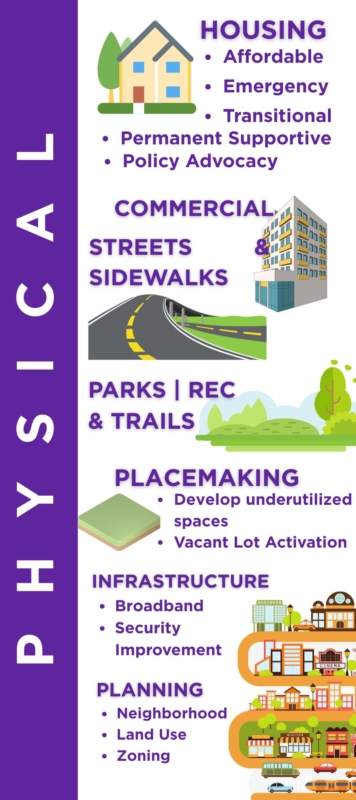
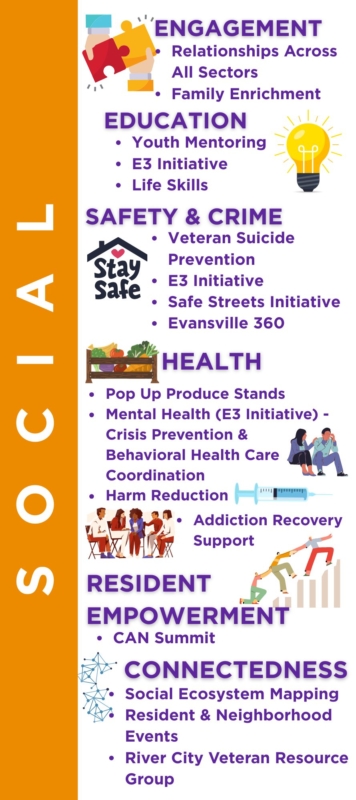
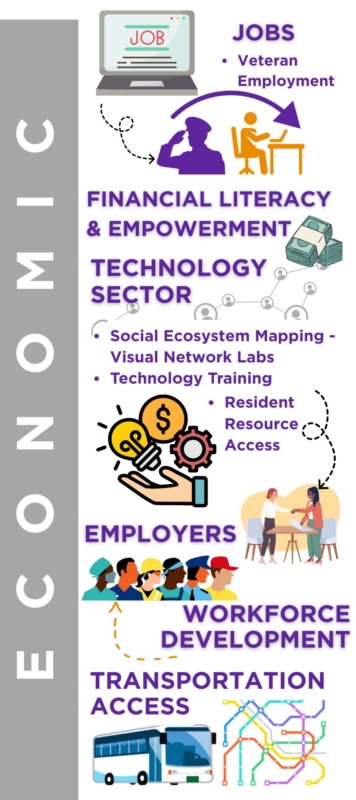
As the lead agency for the 10-year Promise Zone designation, ECHO has driven neighborhood revitalization through economic development, affordable housing, healthcare, crime reduction, job development, and education. With the designation ending in 2026, we have connected with community partners on a sustainability strategy in 2024, focusing on collaboration.
Our transition to the Collective Action Network (CAN) marks a new chapter, expanding our reach to all neighborhoods in need. CAN leverages shared goals, data-driven strategies, and coordinated efforts to address systemic challenges across Physical, Social, and Economic Development.
Community-Led • Data-Driven • Systems-Connected
Philosophy: ECHO’s approach is built on the belief that strong neighborhoods emerge when residents, partners, and systems share leadership, information, and purpose. We build communities with people-not for them.
Guiding Principles
• Relationships are infrastructure
• Data is power
• Residents are experts of their own experience
• Physical, social & economic conditions must be reinforced simultaneously
• Change must be collaborative, inclusive, sustainable, and measurable
Framework: ECHO’s community development work operates through a three-part framework:
1. Collaborative Infrastructure – The Collective Action Network (CAN)
ECHO serves as the backbone entity for CAN, coordinating regional cross-sector collaboration through:
• Partner convenings and relationship alignment
• Shared goals and workgroup facilitation
• Annual CAN Summit
• Shared workplans
• Strengthening partner coordination across social, physical, and economic domains
2. Social Ecosystem Mapping – Visible Network Labs (VNL)
VNL is the intelligence backbone for community development planning. It:
• Maps partner relationships and identifies gaps
• Measures collaboration quality and trust
• Tracks network density over time
• Produces real-time analytic reports
• Prioritizes neighborhoods for targeted intervention
3. Focus Areas – Physical, Social & Economic Development
All initiatives align to one or more of the following domains (examples within each):
Physical Development – Housing stability • Redevelopment • Safety improvements • Public space activation
Social Development – Resident engagement • Mental health/wellness supports • Crisis response • Youth & family opportunity • Community connectedness
Economic Development – Workforce mobility • Small business support • Financial stability • Entrepreneurship pathways
Community Voice & Public Engagement
Residents guide the strategy through: Neighborhood association meetings • BRIDGE meetings • CAN Summit feedback • Listening sessions • VISTAs embedded in neighborhoods • CANdid Conversations • Informal community conversations • Resident advisory input
Resident experiences directly inform program design, pilot creation, and partner alignment.
Measurement & Accountability
ECHO measures:
• VNL network health indices
• Partner commitments and collaboration quality
• Resident feedback and sentiment
• Neighborhood-level indicators
• Shared community metrics
• Qualitative and quantitative impact stories
Data drives decision-making and system change.
Our Role:
• Backbone Coordinator: Convenings, shared goals, alignment
• Network Intelligence Hub: VNL analysis and data-guided strategy
• Place-Based Strategist: Resident-led planning, neighborhood revitalization, safety partnerships
• Mobility Pathway Integrator: Aligning workforce, stabilization, and economic partners
• Narrative Builder: CANdid Conversations and public communication
Outcomes Since Formation of CAN (Fall 2024–Present)
Governance & Infrastructure
• CAN Governance Team formed to support structure and decision-making
• AmeriCorps VISTAs deployed in priority neighborhoods to gather real-time resident insight
Model Recognition & Replication
• E3 Initiative recognized statewide through the MCAP award
• Group Violence Intervention (GVI) revitalized

The Collective Action Network (CAN) is a cross-sector group of community leaders who come together to create change. Using the collective impact model, this approach unites multiple organizations to tackle systemic challenges through shared goals, data-driven strategies, and coordinated efforts. Together, we strive to enhance community outcomes and build a stronger support system for vulnerable populations.
Expanding our focus through CAN allows us to serve all neighborhoods in need, rather than being limited to specific areas defined years ago. Our initiatives now span three key areas: Physical, Social, and Economic Development, where we serve as the backbone organization for collective efforts.
As a member of the University of Evansville’s Evansville Promise Neighborhood (EPN) core team, we are invested in all out comes, but as a community development organization, we are particularly interested in Pipeline Block 4 – Improving Neighborhood & Community. The four solutions in this pipeline include
ECHO leads initiatives in all of these areas and employs a Housing Policy Director to advocate for policies that result in greater family and neighborhood stability.